Biwin was showing off their new Mini SSD at CES, and it is not just another card format. SemiAccurate thinks this is an interesting idea and hopes it will get traction in the market.
The idea is simple, take a small SD card size device and imbue it with SSD class performance. While this is harder than it sounds, several have done it before but none have achieved market traction or standardization. Lets take a look at the Mini SSD and you might understand why we hope it takes off or better yet gets blessed by a major standards body.
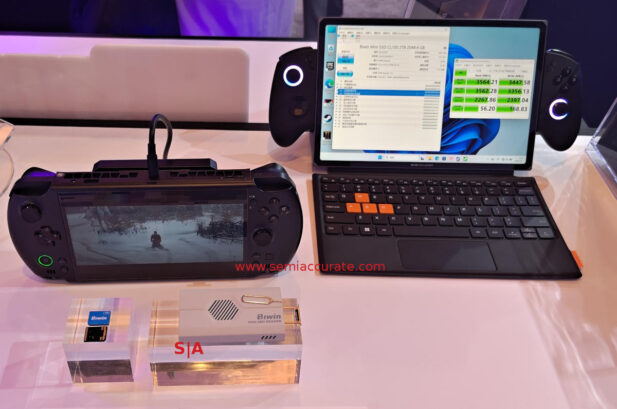
The Mini SSD, reader, and two handhelds
The Mini SSD is on the left, the Biwin RD510 reader on the right, and the SIM remover pin on top of the RD510. Note the carrier which slots into the reader on the right, our crappy picture doesn’t make it easy to see. On top there is the GPD Win5 Steamdeck-esque handheld and to the right is the OneXPlayer X1 Air PC/gaming platform. Both accept the Mini SSD directly, likely chosen for performance per unit area under gaming and some features not possible on removable cards like SD.
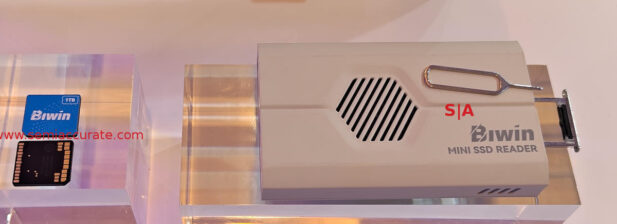
Mini SSD, reader, cradle, and eject pin thingy
The SIM/cradle thingy is a bit annoying for daily use but for the X1 Air and Win5 they are perfect. You put them in and they work, and work fast. Since they come in 512GB/1TB/2TB sizes, you probably won’t need to swap them very often, you are effectively trading a little convience for performance, exactly what you would want for gaming. Additionally if they aren’t hot swappable, you don’t need to have the performance sapping shims between the device and the OS, you can map memory like an SSD, and more. Small transactions can be optimized and bundled into much lower latency mechanisms that you can’t do if the device is hot pluggable. These tradeoffs are understandable but we would still prefer an SD style push to eject mechanism despite the possible downsides.
Back to the Mini SSD, they currently run as PCIe 4×2 devices and support the NVMe1.4 protocol. Speeds are up to 3700/3400MBps R/W so pretty damn good for a small device. If you consider how thermally limited these packages are, no M.2 5×4 massive heatsink here, that is all the more impressive. Thermals are always an issue in small storage but considering the two devices on the market that use the Mini SSD for gaming, it looks like an easily solved problem.
In the end the fate of the Mini SSD form factor will come down to standards body acceptance, a long road in the best of times. The devices that use them are on the market now, they work, and you can get a USB-C reader if you don’t have either of the two handhelds mentioned. AMD’s Mantle, PCIe 6/8 pin power plugs, Gigabyte putting more amps into a USB port, and dozens more ‘non-standard’ ideas that were useful have all been adopted by standards bodies, and many more are now taken for granted. Since we need a better mobile storage standard than what we have now, lets hope Mini SSD becomes one of these things we all take for granted in the future.S|A