Several American filmmakers have also borrowed liberally from Kon’s boldly surreal visual language, including Darren Aronofsky, whose Requiem for a Dream and Black Swan mimic Perfect Blue to a concerning degree. Other homages to Kon’s body of work are subtler, such as Christopher Nolan’s Inception, which draws from the DNA of Kon’s Paprika but is distinct enough to forge its own identity.
Paprika is a convoluted psychological thriller with outlandish sci-fi elements. Like most of Kon’s work, this 2006 animated film defies straightforward interpretation, operating on abstract imagery and mind-bending logic. Set in a futuristic world with cutting-edge technology, Paprika centers on Dr. Atsuko Chiba, who treats her patients using an experimental device called the DC Mini, which allows the user to enter other people’s dreams.
When Atsuko uses the DC Mini to treat those not enrolled in her research facility, she assumes the playful persona of a detective, whom she names Paprika. Using breathtaking transitions and hallucinatory visuals, Kon blurs the lines between illusory dream states and waking realities. As the film progresses, it becomes increasingly difficult to pinpoint where Atsuko’s carefree alter-ego begins or ends.
But Paprika’s dizzying narrative bent is apparent from the very beginning. Kon uses the film’s dramatic opening credits to establish the whimsical, disorienting nature of his story in under two minutes. We are introduced to the cheerful Paprika, who glides and floats through the streets of Tokyo while disregarding the laws of physics, which immediately tints our perception of the film. In this opening sequence, Paprika hops across billboards, stops time to skip across a crowded intersection, and emerges out of a monitor like a digital hologram.
There’s a seamless fluidity to these beautiful transitions, which Kon uses to establish Paprika as the unfettered unconscious in Atsuko’s mind. Even when Paprika is stuck in a mundane scenario, such as when her solitude is disrupted by two men at a diner, her annoyance is reflected in four mirrors, which capture four distinct micro-expressions.
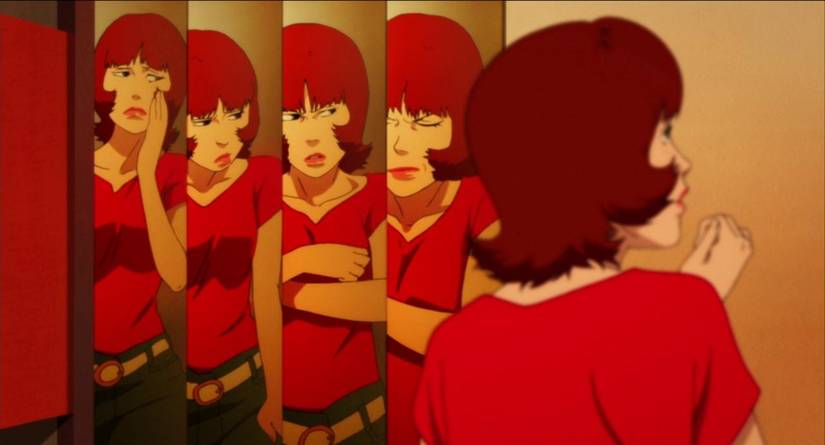
At this juncture, we have yet to meet Atsuko, but Kon’s brilliant opener sets up certain expectations for her titular alter-ego. Paprika dramatizes a psychological tug-of-war between the serious, by-the-book Atsuko and the carefree, charming Paprika, who can only exist in the dream worlds created by DC Mini. The conflict lies in reconciling these disparate identities, along with their inner workings that are (quite literally) worlds apart.
Kon’s opening credits underscore the limitless freedom represented by Paprika, who can easily leap behind a passerby to escape horrible men and re-emerge through a picture of herself on someone’s T-shirt. Such meta-textual animation not only looks effortlessly cool but also boasts a mastery over the medium, as Kon plays with the very fabric of a shared dream.
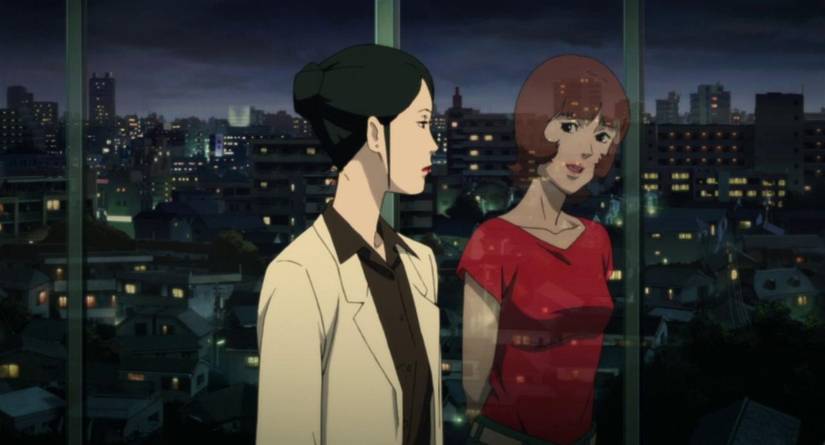
Paprika’s astounding, dramatic entrance would be incomplete without Susumu Hirasawa’s “Mediational Field,” an upbeat yet anxiety-inducing soundtrack that anticipates some of the more pleasantly bizarre sequences in Paprika, like when our protagonist flies over the city. The credits end with her vibrant hair blowing freely in the wind, only to transition into a shot of Atsuko, whose hair is tied up neatly to convey restraint.
This shift to a somber tone feels like a cruel reality check. The lovely, sweet dream is over, giving way to the horrific nightmares in store for a protagonist whose mind has fragmented beyond recognition.