Buzzwords such as artificial intelligence (AI) and machine learning (ML) have become integral to today’s mobile applications, platforms, and tech business ecosystems. However, they aren’t just fads. They drive meaningful technological innovation.
If you are looking for a clear, straightforward answer, this guide breaks it down simply. In its most basic definition, Machine learning is a subfield of artificial intelligence that enables systems to learn from data and make subsequent intelligent decisions without additional human input. Machine learning is largely responsible for transforming the digital economy through mobile apps, custom software, and predictive analytics, and continues to drive impactful innovation across a multitude of applications.
This article will analyse its core operating principles, types, advantages, applications, limitations, and related considerations to provide a comprehensive understanding of its use, including its potential impact in 2026 and beyond.
Key Takeaways
- Machine learning enables systems to learn from data and improve without manual programming.
- It powers automation, personalization, and predictive analytics across industries.
- High-quality data and ethical design are essential for accurate, unbiased outcomes.
- Machine learning is a long-term driver of innovation, scalability, and competitive advantage.
Market Trends and Growth Outlook for Machine Learning
Machine learning continues to experience rapid global adoption, driven by rising AI investments, expanding data availability, and enterprise demand for intelligent automation.
- The global machine learning market is projected to grow rapidly, with forecasts indicating it could reach around USD 90.1 billion by 2026, driven by strong growth leading up to that year.
- The combined AI and machine learning in the business market is expected to grow by more than USD 240 billion between 2025 and 2029, with an estimated CAGR of around 24.9% as companies increase adoption of AI automation and predictive analytics.
- The global artificial intelligence market (within which machine learning plays a central role) is projected to grow from an estimated USD 375.93 billion in 2026 to roughly USD 2.48 trillion by 2034, exhibiting strong, sustained growth.
What is Machine Learning?
Machine Learning (ML) is a subfield of Artificial Intelligence (AI) that enables systems to learn from data, identify patterns, and improve over time without being explicitly programmed. Machine learning (ML) models perform classification, prediction, and analysis and rely on a dataset to make decisions, unlike systems that use predefined rules. This enables ML systems to learn from data and make decisions.
Typically, programming tells a system exactly what actions to take in a step-by-step manner, however, in ML this is not the case since the system sets rules by itself from its training data. These systems are capable of performing extremely difficult tasks, making modern AI software development exceptional. ML is an essential component of modern problem solving in Natural Language Processing (NLP), facial recognition software, automated systems, intelligent automation, etc.
What are the Different Types of Machine Learning?
Machine Learning can be classified by how models obtain data, how they are trained, and how much human interaction is required. Each serves specific applications in AI automation, predictive systems, and more.
1. Supervised Learning
Supervised learning is the most widely used form of machine learning in artificial intelligence. This method relies on labeled data. Here, both the input and the target outcome is already pre defined. The algorithms will understand the correlation between the input and the target outcome and can forecast the outcome for previously unseen data.
An example could be predicting future house prices from historical data, or differentiating between regular and spam emails using labeled instances. Common algorithms that are used in supervised learning are linear and logistic regression, decision trees, random forests and support vector machines (SVMs). Supervised learning finds a lot of applications in predictive analytics, and natural language processing tasks such as sentiment analysis and fraud detection.
2. Unsupervised Learning
In the case of unsupervised learning, data do not have specific labels that are defined, thus the system does not have any pre-defined labels. The system is designed to analyse data to identify structures, relationships, or hidden patterns.
A typical example of supervised learning is customer segmentation, where businesses classify customers into groups based on their behaviour or preferences to provide a more tailored experience. Commonly used algorithms for unsupervised learning include hierarchical clustering, k-means clustering, and PCA (Principal Component Analysis). This type of machine learning is often applied in AI software development for recommendation systems, anomaly detection, and exploratory data analysis.
3. Reinforcement Learning
In reinforcement learning, an agent uses trial and error to make decisions within an environment. Based on the actions the agent takes, it receives a reward and learns to maximize these rewards. The agent refines its decision-making process to optimize the actions it takes to maximize rewards.
To illustrate, consider a common example of reinforcement learning: training pets. They receive a reward (like a treat) for exhibiting a desired behavior. Use cases for reinforcement learning in the real world include real-time decision-making systems, self-driving cars, AI that plays games, and robots. Prominent algorithms include policy gradient methods, deep Q-networks (DQNs), and Q-learning.
4. Semi-Supervised Learning
Semi-supervised learning combines supervised and unsupervised learning. Models in this type of learning are trained on a limited (or small) amount of data that has been marked (or labeled) in conjunction with a large amount of data that has no labels.
This is the case in image classification and natural language processing (NLP) where it is very costly and tedious to label (or mark) data. Semi-supervised learning reduces the amount of labeled data required and improves model accuracy. This learning approach is applicable in large-scale AI systems with abundant data, such as speech recognition and text classification, and in settings with sparse labeled data.
5. Self-Supervised Learning
In self-supervised learning, a system constructs its own labels autonomously, as it doesn’t depend on outside annotations. Instead, the model is trained on the data by predicting what the input could be to either fill in a missing space or unmapped input.
This strategy is fundamental in the preparation of extensive language models and sophisticated NLP systems. Self-supervised learning equips AI models to understand the contextual relationships among text, images, and audio at scale. It is essential to the advancement of computer vision, natural language processing, and representation learning in AI software development.
6. Online (Incremental) Learning
The mechanism of online learning is to continuously train a machine learning model on data streamed in real time. Instead of undergoing training once with a specific dataset, the model retrains itself depending on the data presented.
This method is particularly useful in environments where data is constantly changing, such as financial markets, recommendation systems, fraud detection systems, and real-time analytics. Online learning enables rapid adjustment, which is particularly useful for scalable and responsive AI systems.
Different machine learning models are designed for specific goals. The best choice of model varies with availability of data, complexity of the problem, and the objectives of the business. The combination of learning methods fuels smart systems that are central to predictive analytics, personalization, automation, and other cutting-edge innovations in AI software development and natural language processing.
| Type of Machine Learning | How It Works | Common Use Cases |
| Supervised Learning | Trained on labeled data | Price prediction, spam detection |
| Unsupervised Learning | Finds hidden patterns | Customer segmentation |
| Reinforcement Learning | Learns via rewards | Robotics, game AI |
| Semi-Supervised Learning | Mix of labeled & unlabeled data | Speech recognition |
| Self-Supervised Learning | Learns from data itself | NLP, large language models |
| Online Learning | Learns continuously | Fraud detection, recommendations |
Real-World Applications of Machine Learning in Different Industries
Smart decision-making, automation, and continuous innovation have been enabled by machine learning, enhancing nearly every industry. It has proven essential in today’s digital environments, as it learns and adapts to real-time data. Here, we’ll examine a few positive uses of machine learning.
- Healthcare: Thanks to machine learning, healthcare has improved patients, their future medical problems, analyzed medical data, and diagnosed problems in advance. It has also helped plan treatments.
- Banking and Finance: Machine learning has been instrumental in real-time fraud prevention, credit risk evaluation, and trade transactions.
- Retail and E-commerce: In this field, machine learning has made significant advances, enhancing the customer experience. It has helped in the preparation of recommendations, demand estimation, price assessment, and inventory control to improve service and operational efficiency.
- Mobile App Development: Modern mobile app development uses machine learning for many applications, such as voice recognition, language translation, face recognition, smart filtering, and personalized user experience.
- Web Development: In website personalization, machine learning is used for content recommendations, user behavior analysis, and AI chatbots to increase participation and conversion rates.
What Role Does Machine Learning Serve?
Defining machine learning can be difficult, but it involves the ability to streamline sophisticated tasks, discover and develop previously unrecognized patterns, and enhance decision-making without human input. For example, machine learning can be used to develop intelligent automation systems, predictive analytic systems, and even advanced digital products.
Challenges and Limitations of Machine Learning
Machine learning does provide many advantages; however, there are several challenges that do need to be taken into consideration. If we want to develop high quality, ethical, and scalable AI systems, we need to understand these challenges.
- Data Quality: In order to have a functioning machine learning model, there must be high quality data that is relevant to help aid in the creation of the model. If the data is flawed or missing information, the model will produce inaccurate predictions and outcomes.
- Bias in Models: In the event that the data sets used to train the model have bias in them, the machine learning systems created will reinforce the bias and this will lead to unbalanced and unfair outcomes. Data bias needs to be addressed and acknowledged to develop a responsible AI.
- Resource and Complexity: Developing and training the machine learning model in real time requires extensive resources and can be costly. Also, the time it takes to develop the models is extensive.
- Interpretability: Black-box models are hard to interpret. If understanding how the model makes its predictions is important to the system, this can hinder the models used in these systems.
- Overfitting: This model is prone to overfitting. When a model overfits, it learns the training data too well. When this happens, it makes it difficult for the model to perform in the real world when presented with new, unseen data.
Well-governed, carefully designed, and ethically assured machine learning projects are essential to building long-term trust and successful systems.
Benefits of Using Machine Learning
Machine learning accelerates and improves the sophistication of decision making while increasing the level of scalability. Below are some of the benefits of treating machine learning as a technology.
- Automation: It saves time by eliminating the need for manual inputs and creating workflows, while also decreasing the possibility of human-made errors.
- Scalability: Machine Learning system uncover important insights by analyzing and processing larger volumes of data than any human can.
- Personalization: Machine Learning fine-tunes systems to individual user profiles by adapting to user behavior and preferences, improving the customer experience.
- Accuracy: Machine Learning models can achieve higher accuracy than traditional rule-based models, particularly in fraud detection, medical diagnosis, and predictive analytics.
- Innovation: With Machine Learning, intelligent capabilities and data-driven experiences are enabled, increasing innovation across web development, mobile applications, and custom software solutions.
All the benefits listed above make Machine Learning indispensable for any organization seeking to be flexible and ready for a competitive, data-driven future.
What is the Future of Machine Learning?
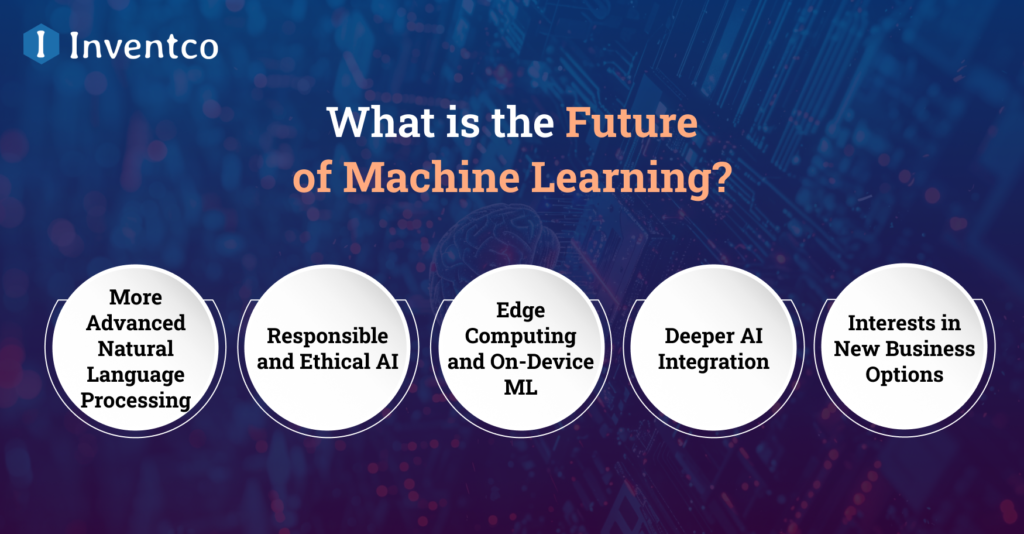
The rapid development of machine learning is driven by a large number of factors including refinement of algorithms, increased computing power, and the availability of quality data. As companies integrate machine learning into more of their digital products and processes, several key trends are shaping the future of machine learning.
1. More Advanced Natural Language Processing
Natural language processing (NLP) is expected to improve to more human-like performance and greater contextual understanding. Upcoming ML models are expected to drive improvements in voice- and text-based conversational AI and language understanding systems that can grasp user intentions, emotions, and broader contextual information.
2. Responsible and Ethical AI
Machine learning as a process and its outcomes are being subjected to more scrutiny, and calls for fairness and accountability are on the rise. Responsible AI practices that help reduce bias and improve accountability and explainability are expected to drive more ML framework development.
3. Edge Computing and On-Device ML
Incorporating machine learning models into smartphones, wearables, and IoT devices is expected to eliminate some cloud dependencies. It will also improve performance and privacy and will be a significant driver of innovation in mobile app development.
4. Deeper AI Integration
Machine learning will continue to enhance artificial intelligence systems by enabling more autonomous, adaptive, and self-improving applications across industries.
5. Interests in New Business Options
With the help of machine learning across new areas of business, such as education, healthcare, smart infrastructure, and agriculture, new business models can be developed that reform and transform industries and many aspects of professional and everyday life.

Conclusion
Continuous advancements in Artificial Intelligence applications across several sectors has positively impacted the bottom line for mid to large-size organizations. Benefits include the development of applications that provide users with personalized experiences, the ability to embed analytics to provide actionable insights, and custom software solutions that evolve with user needs.
However, ML challenges include algorithmic bias, black-box issues, and the need to build a transparent framework for articulating reasoning. These challenges must be addressed to deliver on the promise of ML sustainably.
The transformative potential of AI and ML remains significant. AI applications will be data driven, with ML acting as a catalyst for enhanced innovation and effective automation and decision making.
FAQs
Q1. How to define machine learning with an easy example?
Ans. Machine learning is a mechanism to train computers to learn through data and produce or predict something without actually being programmed. For instance, a system can be trained to identify cats in pictures by studying different cat pictures.
Q2. What’s the difference between AI and ML?
Ans. AI is a broad term used to denote intelligent systems that mimic human thinking. ML is a kind of AI that deals with learning from data. In brief, all that is ML is AI, but not all that is AI is ML.
Q3. Is ChatGPT AI or machine learning?
Ans. ChatGPT is both AI and machine learning. It is an AI based on machine learning. It is based on ML called deep learning, which works on neural networks for language processing.
Q4. Can AI exist without ML?
Ans. Yes, AI can be developed without ML. Rule-based systems were employed in some of the previous AIs. These rules were explicitly programmed by the programmers. But ML is the standard for developing AIs nowadays.
Q5. Will AI replace ML?
Ans. No, AI will not replace ML. ML is one of the foundations of AI, and progress in ML will only propel AI further. They’re alternatives, not substitutes.

Jitendra Jain
He is the CEO and Co-founder of Inventco, driving innovation in advanced computing and digital transformation. With deep expertise in modern IT ecosystems, he leads scalable, secure, future-ready solutions. His strategic leadership helps businesses accelerate growth, adopt innovation, and achieve success. You can connect with him on LinkedIn to follow his technology insights.